Mettā-Bhāvanā (Venerable Chanmyay Sayadaw)
Foreword
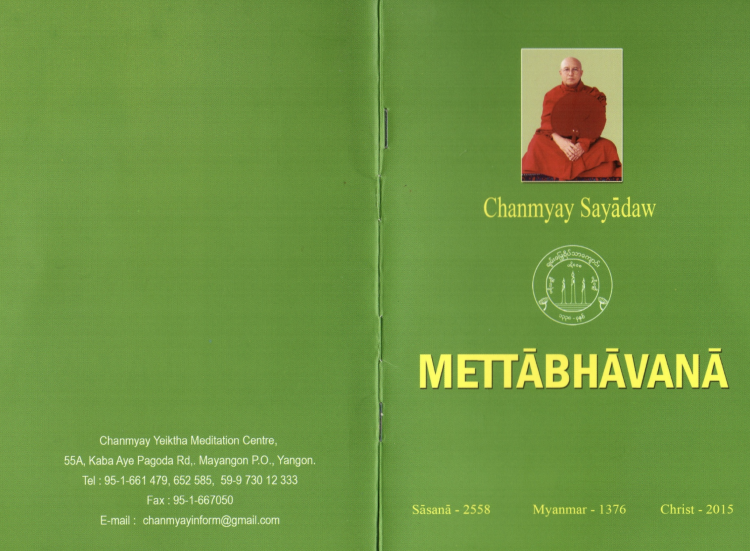
I delivered a Dhamma talk on mettā-meditation on a meditation retreat in New Zealand in November 1992. The talk is now tran-scribed by meditators and printed in a book form after it has been edited. The book is published in commemoration of the second ceremony of Acariya Puja in honour of the most venera-ble Chanmyay Sayadaw on January 17, 18, 19, 2015.
Namo Tassa Bagavato Arahato Sammasambuddhassa
Mettā means a mental state wishing for the welfare of all living beings, hitakarapavattilakkhana mettā. The meaning is that mettā has the characteristic of wishing the welfare of all living beings. The mental state that wishes all living beings to be happy and peaceful is mettā. When you develop the spirit of loving kindness or mettā towards all living beings, that is called mettā-bhāvanā or mettā-meditation.
Mettā and Tanhā
In the Burmese language the word mettā is used in two senses. One is the sense of loving-kindness; the other is the sense of sen-sual love. When a man is in love with a lady it is said that he loves her, he has mettā for her. In this case mettā is not used in the sense of loving kindness wishing the welfare of that lady; it is used in the sense of sensual love or desire. The sensual love or desire is tanhā, not mettā (loving kindness).
When we deliver a discourse on mettā-bhāvanā we have to clarify it, repeatedly distinguishing between the two senses of mettā and tanhā. Mettā has the characteristic of wishing the wel-fare of beings without attachment while tanhā has the charac-teristic of clinging to the object. Mettā is cool while tanhā is hot. Mettā makes the mind pure, calm, cool and concentrated while tanhā makes the mind defiled, distracted and hot.
Some people say that you should radiate your mettā towards all living beings. Unless you develop mettā in yourself, how can you radiate it to other living beings? If you have developed the spirit of mettā abundantly in yourself, you need not intentionally radiate it to other beings. Your mind is naturally radiating mettā to them all.
When you wish the welfare of other beings you have mettā in yourself. When mettā is well developed in yourself, your face looks calm, serene, pleasant, happy and peaceful. Sometimes your face looks smiling. Anyone who meets you and sees your face, feels happy and peaceful by the power of your mettā. He has the feeling of mettā for you. These are some benefits of mettā-bhāvanā, mettā-meditation. More benefits of mettā-meditation are mentioned in Buddhist scriptures. Lord Buddha explained eleven benefits of mettā in his teaching.
Eleven Benefits of Mettā
In the Anguttara Nikaya, the Omniscient Buddha explains eleven benefits of mettā as follows:
- The mettā meditator sleeps well.
- He wakes up happily, feeling refreshed.
- He has good dreams.
- He is dear to human beings.
- He is dear to other beings such as Devas.
- He is protected by Devas.
- He is not harmed by weapons, poison and fire.
- His mind is easily concentrated.
- His facial expression is calm, clear, serene and peaceful.
- At the time of death, he passes away peacefully without confusion.
- When he has passed away, he is reborn among Brahmas.
A Young monk
In the Visuddhimagga commentary we find the story of a young monk who practised mettā-meditation. In ancient times in Sri Lanka a young monk, named Visākhā, practised both mettā-bhāvanā and vipassanā-bhāvanā. He stayed at a place for four months, he did not stay longer at one place. In this way he moved from one place to another. At one time he stayed in Cit-talapabbata Vihara. He intensively practised mettā-meditation there. After he had stayed there four months, he was about to leave Cittalapabbata and go to another place. In the last night he practised mettā-meditation while walking. At that time he heard someone crying nearby. He looked for the person who was cry-ing. He did not see anyone. So he asked, “Who is crying?”
Then he heard, “Venerable sir, I am the deity who lives in this tree”. Then Visākhā asked, “Why are you crying?” The de-ity answered, “Venerable sir, you are going to leave this place tomorrow, so I am crying”. Then Visākhā said, “My leaving this place has nothing to do with your crying”. The deity said, “Ven-erable sir, before you came and stayed here, some Devas in this forest were quarrelling and fighting one another. We had to stay always unhappily. There was no unity and no peace at all. When you came and stayed here, all Devas here were no longer quar-relling nor fighting. All Devas loved one another. We live very happily because of your mettā. Now you are going to leave here. Devas will quarrel and fight again. Then we will have no peace and happiness again. So, Venerable Sir, I request you not to leave from here”. Venerable Visākhā, an intensive mettā-meditator, considering the welfare of all Devas there, decided not to leave Cittalapabbata and stayed on there. So, the Devas loved one an-other and lived in peace and happiness all the time.
This story of a young monk is described in the Visud-dhimagga to prove some benefits of mettā-meditation.
Mettā-Meditation
When you wish to practise mettā-meditation, you have to take any person or any beings as the object of meditation because you wish to develop mettā to some persons or beings, wishing him peace and happiness. For example, you wish to practise mettā-meditation for your mother. You must focus your mind towards your mother and reflect on her peace and happiness, thinking about her good character, good deed and good speech and say mentally, “May my mother be well, happy and free from suffer-ing”. These mettā sentences must be recited repeatedly. They arouse the feeling of your mettā for your mother. However, the sentences should be two or three, not more than that. They also should not be long, but should be short. If the sentences are many or long, the mind sticks to them. Then the feeling of mettā does not arise. So meditators should be careful not to use many and long sentences.
No Need to See Image
Some people have the idea that in mettā-meditation a meditator needs to see the image of the person who is the object of med-itation. This is just their idea. The Visuddhimagga does not in-struct to see the image of the object. Therefore, you should not try to visualize the image of the object. It is impossible to see all images of all living beings when we develop mettā to all living beings. So meditators, without trying to see the image of object, should focus their mind towards all living beings and mentally say mettā sentences, “May all beings be well, happy and free from suffering”. He may use other short sentences that enable him to arouse the feeling of mettā. In this way he will be able to develop mettā.
Automatic Appearance of the Image
But sometimes the image may appear automatically or naturally in your mind without your effort to visualize it; it’s good. Later the image may disappear; it doesn’t matter. What does matter is to feel loving-kindness in yourself, recollecting all the virtues of the object, wishing him peace and happiness.
Two Types of Mettā-Meditation
Mettā-Meditation is of two types. One is specific mettā and the other is unspecific mettā. If you specify a particular person or group of persons as the object of meditation, that is specific mettā-meditation. If you cultivate your mettā towards all liv-ing beings without any specification, that is unspecific or non-specific mettā-meditation. Specific mettā is called odhi mettā and unspecific mettā is called anodhi mettā.
Specific Mettā-Meditation
When you practise specific mettā-meditation you should focus your mind towards a person whom you have chosen as the object of the meditation. Then you should reflect on his welfare and mentally say, “May this person be well, happy and free from suf-fering”, recollecting his good character, good deeds, good speech etc. In this way mettā sentences gradually arouse the feeling of mettā in yourself, which later will be well developed.
Unspecific Mettā-Meditation
As to unspecific mettā-meditation you are not to specify any per-son or group for the object of the meditation, but you develop your mettā towards all living beings, mentally saying, “May all beings be well, happy and free from suffering”. Repeatedly, you can use such sentences as these, “May all beings be happy, free from animosity, distress and affliction”.
Points to Note about Specific Mettā
The Visuddhimagga mentions four kinds of person who should not be the first object of mettā-meditation in the initial stage of the practice:
- An antipathetic person should not be the first object of mettā-meditation in the beginning of the practice; if you put the antipathetic person in the place of the beloved one, you find it difficult to feel mettā and get tired.
- A dearly beloved person should not be the first object of mettā-meditation in the initial stage of the practice because developing loving-kindness towards him or her, sometimes you may think about his or her misfortune or suffering. Then you will be unhappy about it and unable to feel loving-kindness for him or her.
- A neutral person should not be the first object of mettā-meditation. A neutral person is the one whom you do not love nor hate. He is just your acquaintance. If you put a neutral person in the place of the beloved one, it is difficult for you to feel mettā for him.
- A hostile person also should not be the first object of mettā-meditation, because when you reflect on his welfare, you may have anger arising in your mind instead of mettā.
The above mentioned four persons should not be the first object of mettā-meditation in the initial stage of the practice. When you are skilful in mettā-meditation, you can develop mettā towards them.
A Man Fighting Against the Wall
There is one person who should not be the object of specific mettā-meditation. The opposite sex should not be the object of the specific mettā-meditation because the meditator may feel lust instead of mettā. In the Visudhimagga an interesting story is mentioned. In Sri Lanka, a man very much wished to practise mettā-meditation. He asked a monk, who came to his house ev-eryday for alms round, how to practise mettā-meditation. The monk told him to cultivate mettā towards his most loved one. At night, the man comfortably sat for meditation in his room and thought about object of meditation who he loved most. It came to his mind that his wife was best loved by him. So he culti-vated mettā towards his wife who slept in the other room. When he developed mettā for some minutes, he had lust arising in his mind and so he got up and tried to go to his wife’s room fight-ing against the wall of his room which was bolted, but he forgot it. In consideration of this story the opposite sex should not be the object of the specific mettā-meditation but he or she can be the object of unspecific mettā-meditation. When you are skilled in mettā-meditation, you can develop mettā towards the opposite sex.
A Lady Meditator’s Experience
One lady who was a superintendent at a bank came to practise Vipassan¯a Meditation for two months. She got a three months leave. After two months of Vipassan¯a Meditation, she practised mettā-meditation. After she had practised mettā-Meditation for about two weeks, her concentration was very good. She felt happy, calm and composed. Her mind became clear, serene, pli-able and malleable. I, therefore, instructed her to develop mettā towards a hostile person. Then, she remembered her senior of-ficer who was always finding fault with her. She did not like him. So I told her to develop mettā towards her senior officer. She tried to feel mettā for him by practising mettā-meditation. The next day in the interview she said she was successful in de-veloping mettā towards her hostile person. After one month’s mettā-meditation she went back home. After one week she came and told me about her success. When she went back home her brother told her that her senior officer visited her house and asked her brother about her health and her meditation, which he had never been done before. When she went to the office his attitude has changed and he did not find fault with her. So she judged that this is the benefit of mettā-meditation that she had practised for one month. So we can say that when a meditator is skilled in mettā-meditation he successfully develops mettā to-wards a hostile person.
About a Dead Person
A dead person should not be the object of the specific mettā-meditation. The Visudhimagga says that if you develop loving-kindness towards a dead person, you cannot attain either ac-cess or absorption concentration. It mentions a story of a young monk who developed mettā towards his preceptor living in a dis-tant monastery. The young monk could not attain any concen-tration in his meditation. So, he went to a senior monk who was an Arahat living near his monastery and asked him why he did not attain any concentration in his meditation though he was skilful in mettā-meditation. The senior monk told him to seek the object. So the young monk went to the monastery where his preceptor lived. Then he found that the preceptor had passed away. He came to know that is the reason why he did not attain any concentration. Then he took another person as the object of mettā-meditation. He easily attained absortion concentration (jhāna).
Who is the First Object?
Then we should know who should be the first object of mettā-meditation in the beginning. The Visudhimagga says as follows:
First of all it should be developed only towards one-self, saying repeatedly thus, “May I be happy and free from suffering,” or, “May I keep myself free from enmity, affliction and anxiety and live hap-pily1”.
So he should first, as example, pervade himself with loving-kindness. Next, after that, in order to pro-ceed easily, he can recollect such gifts, kind words, etc., as inspire love and endearment, such virtue, learning, etc., as inspire respect and reverence met with in a teacher or his equivalent or a preceptor or his equivalent, developing loving-kindness towards him in the way beginning “May this good man be happy and free from suffering”. With such person, of course, he attains absorption2.
Breaking of the Barriers
But if this Bhikkhu does not rest content with just that much and wants to break down the barriers, he should next, after that, develop loving-kindness towards a very dearly loved friend, then towards a neutral person as a very dearly loved friend, then to-wards a hostile person as neutral. And while he does so, he should make his mind malleable and wieldy in each instance before passing on to the next3.
Then, he should break down the barriers by prac-tising loving-kindness over and over again, accom-plishing mental impartiality towards the four persons, that is to say, himself, the dear person, the neutral person and then the hostile person.
The characteristic of it is this. Suppose this person is sitting in a place with a dear, a neutral, and a hostile person, himself being the fourth; then bandits come to him and say, “Venerable sir, give us a Bhikkhu”, and on being asked “Why”, they answer “So that we may kill him and use the blood of his throat as an of-fering”, then if that Bhikkhu thinks, “Let them take this one, or this one”, he has not broken down the barriers. And also if he thinks, “Let them take me but not these three,” he has not broken down the barriers either. Why? Because he seeks the harm of him whom he wishes to be taken and seeks the wel-fare of the others only. But it is when he does not see a single one among the four people to be given to the bandits and he directs his mind impartially towards himself and towards those three people that he has broken down the barriers4.
1 The Path of Purification, ch. 9, para. 8.
2 The Path of Purification, ch. 9, para. 11.
3 The Path of Purification, ch. 9, para. 12.
4 The Path of Purification, ch. 9, para. 40-41.
Free Development of Mettā-Meditation
The Visudhimagga, in the above paragraph, explains how to break the barrier (simasambheda) but any meditator can practise mettā-meditation just to have the feeling of loving-kindness in himself without breaking of barrier. He need not follow the or-der of development mentioned in the Visudhimagga.
So, first of all, he develops mettā towards himself. After he has some feeling of mettā in himself he should develop mettā to-wards his teacher, preceptor or any equivalent person which is endowed with sila, samādhi and pañña. After that he can develop mettā towards any person he has chosen for meditation. In this way he can cultivate mettā towards one person after another or all beings in the universe.
May all beings develop mettā and be happy, peaceful and free from all kinds of suffering.
About the Author
The venerable Chanmyay Sayadaw U Janak¯abhivam. sa, born 24 July 1928, is a Theravada Buddhist monk from Myanmar.
He was born in Pyinma village, Taungdwingyi Township, British Burma, on Tuesday, 24 July 1928. His parents were U Phyu Min and Daw Shwe Yee. He started to study the Buddhist scriptures at the age of fifteen as a novice monk. He received the higher upasampada ordination in 1947 and continued ad-vanced studies of Buddhist scriptures. He practised Vipassana meditation under the instruction of the most Venerable Ma-hasi Sayadaw from 1953 to 1954. He was then invited by the State Buddha Sasana Organization to be an editor of the Bud-dhist scriptures in Pali for reciting Buddhist scriptures at the Sixth Buddhist Council in Myanmar.
Starting from 1957, the Venerable Sayadaw spent six years in Colombo, Sri Lanka, where he continued his studies of English, Sanskrit, Hindi and Sinhalese languages. He returned to Myan-mar in June 1963. At the invitation of the state Buddha Sasana Organisation, he took up residence at Kaba-Aye where he edited the publications of Pali Texts.
In 1967, he was appointed by the Venerable Mahasi Sayadaw as a meditation teacher at Mahasi Sasana Yeiktha, Yangon. In 1977 Sayadaw Ashin Janakabhivamsa took up residence at Chan-myay Yeiktha Meditation Center which was donated to him by some devotees and became the abbot of the center. He has been since then well known as Chanmyay Sayadaw.
In 1979 - 1980 Chanmyay Sayadaw accompanied the Most Venerable Mahasi Sayadaw’s Dhamma Mission to Europe and the
U.S.A. He has undertaken many Dhamma missions to countries in Asia, Europe, and the United States. As recently as July 2015, at the age of 87, he travelled to the UK, Ireland, and Canada giv-ing Dhamma Talks.